Plush petting sketch comparison
Categories:
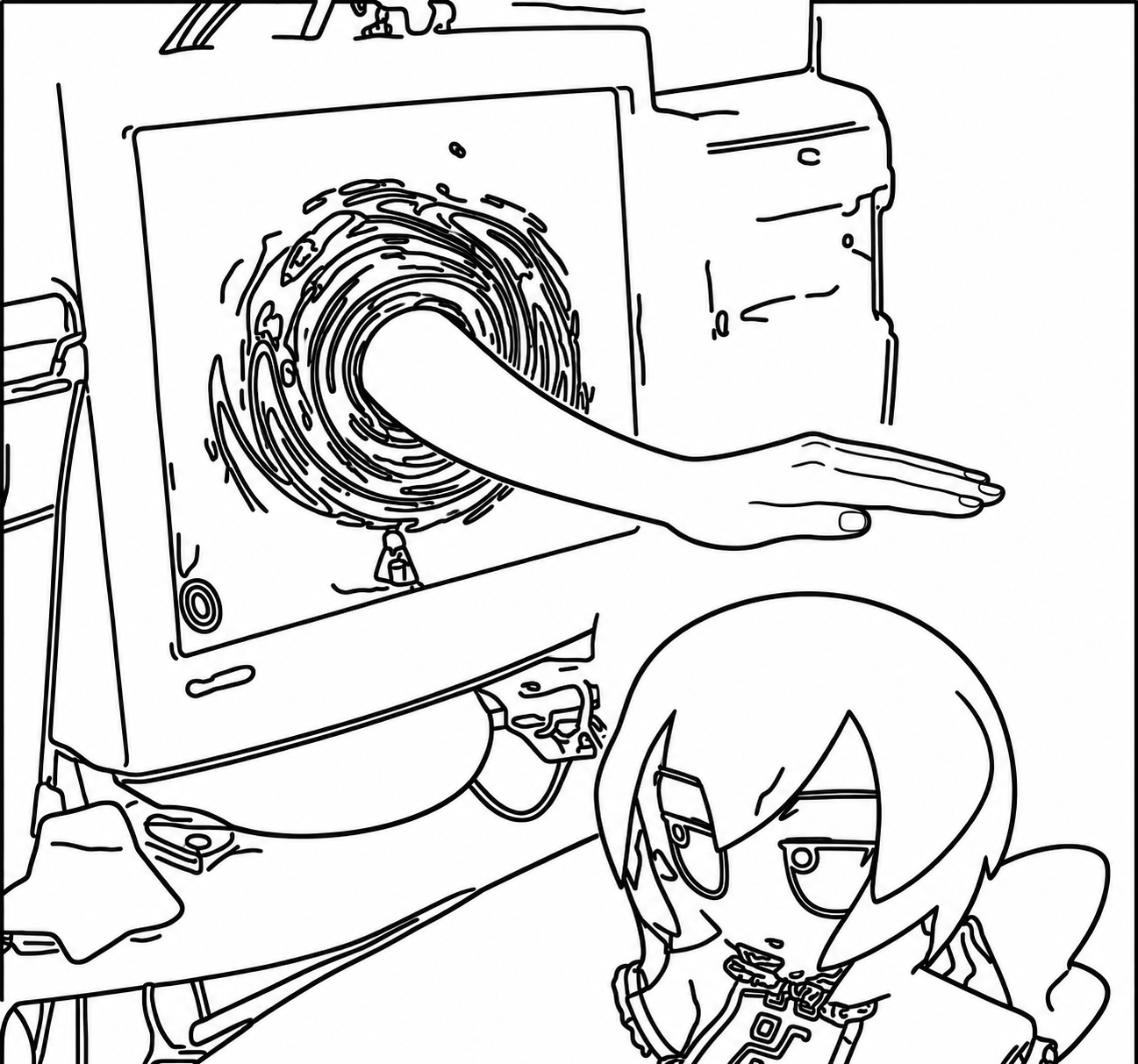
reference.jpg retains the original operator-supplied photograph.
lift-sketch.png is a prepared structural input with one
continuous head outline and a visible gap beneath the entire raised hand.
The sketch is not a Qwen output or a successful animation frame. It simplifies
some details and is not a pixel-aligned mask for the original photograph.
Use these inputs in order:
- Upload
lift-sketch.pngand openqwen-sketch-reconstruction. Run the default full-strength reconstruction and inspect the raw PNG. Reject contact, a second hand, a second crown, disconnected anatomy or a different scene layout. - Once that baseline succeeds, upload
reference.jpgand openqwen-structure-guide-edit. Image 1 remains the same sketch; image 2 adds the original appearance. Keep prompt, seed, negative text and sampling settings identical to the baseline. CompareQwenStructureGuideRawwith the baseline before looking at the optional composite. - If only the second run fails, investigate reference competition. If the baseline also fails, investigate sketch reconstruction before producing a sequence. A successful file or graph execution is not visual acceptance.
The checked-in graphs share the default prompt and sampler configuration. Edits made separately after import do not synchronize automatically. The baseline requires only the sketch; both retain native semantic and VAE image conditioning on positive and negative branches. The appearance workflow also restores original dimensions and produces a feathered composite using the existing repair rectangle. Adjust that rectangle to cover the complete movement; compositing cannot repair pose drift, differing outlines or changed framing.
Sketch provenance and limitations
The built-in image generation editor prepared this input on 2026-11-16 using
the exact asset preparation prompt. Its input was the
white-background scene sketch from the rejected native-reference trial,
SHA-256 81ce3fbee43e508b5caa510de445fe5c893eaf8355ec797ffb6c5567bef1d36f.
That source combined native Canny edges from the public photograph with moved
hand contours and an added crown curve. Inspection found a conflicting retained
outer hair contour; the repaired asset removes that ambiguity. The trial record
retains its lineage and failed Qwen outputs.
The repaired asset is an opaque RGB PNG, 1297 by 1213 pixels, SHA-256
c19aa520a4cc2ee4c809921bd639a3987bcbbb93927958ad71e6fa037610176c.
Visual inspection confirms a single connected forearm/hand silhouette, one rounded crown and a continuous gap. The native Qwen trial records the subsequent GPU comparison: the default sketch-only reconstruction retains the gap and coherent anatomy, while adding the original restores its appearance but introduces unwanted crown folds. Preserve the two variants and compare them at identical settings. Neither command success nor the improved still establishes a finished animation.
The same trial also tests this targeted negative text with the original positive prompt unchanged in both variants:
animal ears, raised ear-like folds on the plush's head, horns, hats, cushions above the hair
It retains a clean sketch-only reconstruction but does not remove the folds with the original appearance reference. It is a recorded experiment, not the default or a verified correction. The saved workflows retain editable negative prompt fields and the original blank default.
Other poses and animation
The default prompt describes the supplied lifted-hand sketch. For a contact or pressing guide, replace its hovering and air-gap instructions with the contact, finger curvature and head compression shown in that guide. Keep image 1 as the target geometry and image 2 as original appearance. An unchanged example prompt can contradict a new sketch.
Approve the sketch motion before reconstructing its distinct poses. Inspect the raw photographs before optional compositing or interpolation: the contact-pose trial preserves hand placement but changes finger arrangement and portal texture between frames. The existing rectangular composite can introduce seams. Fixed seeds and shared appearance references do not guarantee temporal stability.
Photographic pose guides are another input to qwen-pose-guide-edit: prepare a
clean background and a separate hand layer, place the hand at each target pose,
then refine each guide with the original appearance reference. This preparation
is separate from Qwen sampling. In the visible-motion trial,
the image editor prepares the layers and FFmpeg positions them. The earlier
drawn sketch is not an input to that trial.
The trial keeps seed 42, 40 Euler/simple steps, CFG 4 and blank negative text. Start by comparing the lifted and pressed raw outputs at denoise 0.7; the instruction must preserve either a gap or contact according to the current guide. Lower denoise can retain more of the guide, including its defects: 0.45 removes one extra digit but fails to fix a separate skin-texture artifact. Inspect all poses and omit rejected outputs before RIFE assembly. Larger movement exposes the hand-layer warp’s unnatural forearm shape, which Qwen can preserve. The resulting loop demonstrates visible motion, not stable natural anatomy.