Image generation provisioning
Generate a Vault-backed login and rent one HTTPS-protected ComfyUI instance
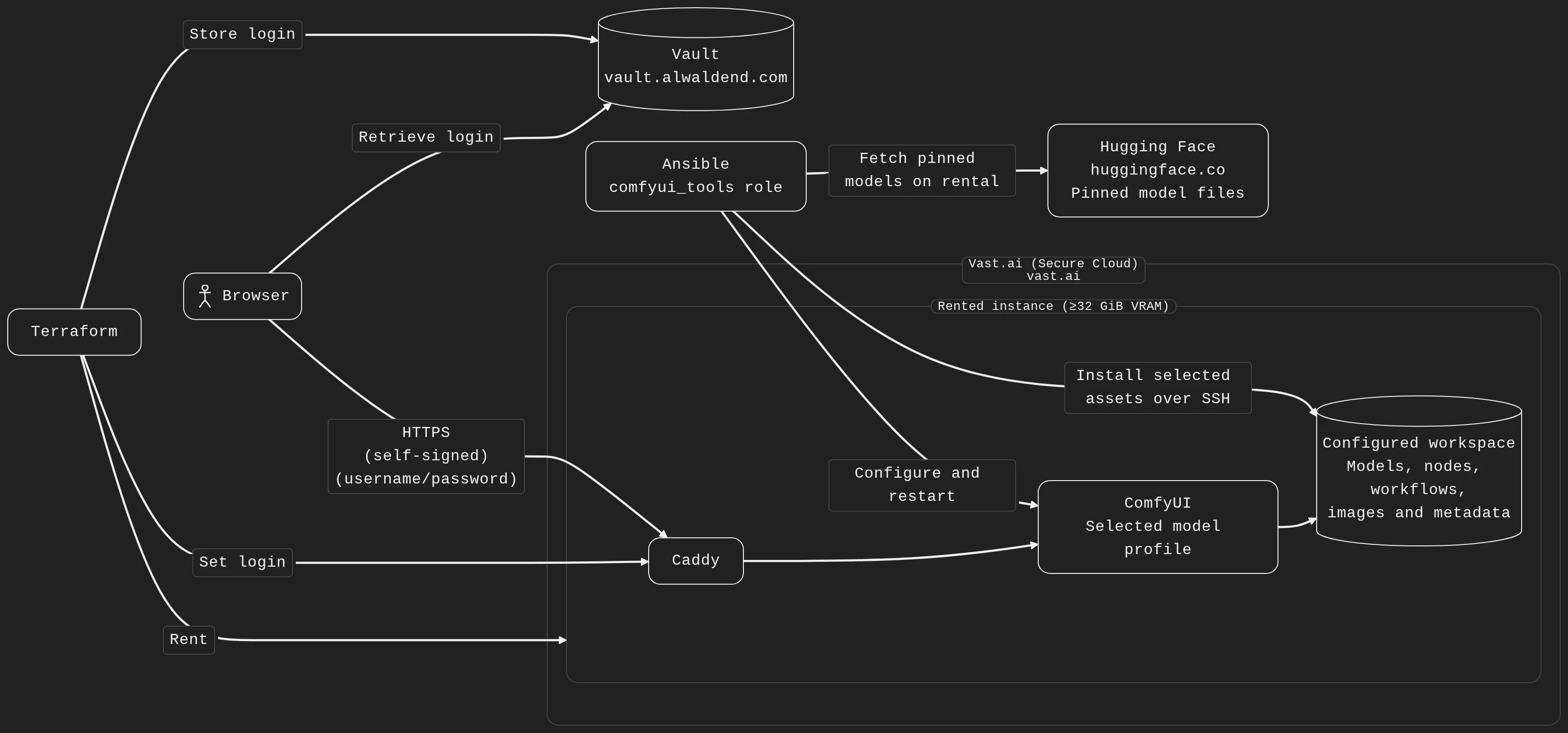
This project owns one image-generation rental in tf_setup.
It uses the reusable ComfyUI module
in exposed mode: a single HTTPS proxy with a generated username/password login,
plus account-key SSH access managed by infra/vastai. The GPU must have at least 32 GiB VRAM.
The configuration selects Qwen-Image-Edit-2511 and the existing
48 GB hardware profile for the operator-requested keyframe animation trial.
The Qwen bundle includes ordinary edits, crop-composited keyframes, selected-frame
GIF assembly, both chained GIF variants and the existing RIFE engine.
NoobAI remains a selectable profile for scene sequences. The NoobAI App has a six-image, two-scene default, persistent references and
one combined GIF, with optional Canny structure guidance and RIFE interpolation.
Separate reference-sequence and scene-composer Apps expose the previous-image
and independent two-pass strategies; the composer uses shared descriptions and
an optional already-installed LoRA instead of image references.
Separate sketch-edit Apps
take a source image and an aligned desired-outline sketch, with a painted-mask
variant for restricted edits. They reuse the existing Canny weights; their GPU
edit quality remains unverified.
The Ansible deployment calls the reusable comfyui_tools
role to install all selected models, LoRAs, node packs, dependencies and native
workflows/Apps, including the pinned interpolation tool when selected.
Terraform provisions the rental and authenticated access. workspace_directory
in the configuration controls the shared workspace path for both stages.
MOSS-Image SFT/Base INT8, full Chroma1-HD, FLUX.2 dev 32B FP8, Juggernaut XL v9,
HiDream-I1 Full 17B, Illustrious XL v2.0-STABLE, FLUX.2 klein Base 9B FP8,
NoobAI XL 1.1 and Qwen-Image-Edit-2511 remain selectable profiles;
see model configuration.
The additional uso and umo-uno profiles provide native FLUX.1 subject/style
and multiple-identity conditioning respectively; both have prompt sequences.
Juggernaut includes the approved IP-Adapter Plus and CLIP vision weights for
several character/style references; NoobAI and Illustrious reuse that SDXL path.
NoobAI’s scene sequence, Canny and interpolated GIF pipeline have completed GPU
execution; precise pose edits and exact character identity remain limited.
Illustrious has offline packaging checks only. HiDream’s GIF
workflow completed the approved eval case, with poor motion/reference quality;
its other workflows remain unverified on a GPU. NoobAI’s publisher prohibits commercial
use of generated products; see the model configuration before selecting it.
Prompt Sequence uses the native multiline
editor; blank lines in line mode provide visual spacing without extra panels.
The component authenticates as src_infra_image_gen, declared by
Vault Terraform. Its own namespace
at mount secrets is alwaldend.com/vault1/approles/src_infra_image_gen:
| Entry | Owner | Purpose |
|---|---|---|
vastai | infra/vastai/alwaldend | Dedicated generated team key (api_key) |
web | This project’s tf_setup | Generated HTTPS username/password |
tf_backend/setup | This project’s backend | Rental Terraform state and lock |
huggingface | Operator or external IaC | Optional gated-model read token |
The existing team root creates and delivers the
key using its own issuer and Vault identity. Its delivery policy covers only
this component’s vastai entry. The rental reads that entry through its own
AppRole; it never reads the team’s operator seed or passes an API key to the
container. The operator can bootstrap the role and browse its KV entries through
existing Vault identity membership. No general infrastructure group is required.
Check remaining team credit before renting or leaving an instance running.
The latest visible-motion trial created 48 GB Qwen instance 60921795 through Terraform and installed it through the shared Ansible role. It completed the owned trials and was retained under the operator’s instruction. Its deployment record owns the dated connection and cost observations. A later Vault authentication failure prevented a fresh provider check during PR completion; the record is not a live status guarantee. The preceding instance 60894930 was destroyed at the operator’s request before this rental was created.
The preceding 48 GB Qwen trial completed four structural-reference still edits and then released test instance 60886376. The hand outline guided the pose, but contact, scene artifacts and duplicate anatomy prevented frame/GIF acceptance. That trial’s connection outputs were cleared; its deployment record records installation, results and teardown.
An earlier rental used NoobAI on the 96 GB RTX PRO 6000 profile, with retention requested. The original ten workflows were uploaded. Its endpoint is now unavailable and the provider lookup no longer returns that instance; the two additional App variants remain packaged for import. The current deployment record owns its instance identity, endpoint observations, in-place installation and sequence/GIF results. Earlier rental observations follow.
The former personal stack was destroyed on 2026-11-10. The replacement AppRole, scoped policies, dedicated team key, generated web login and component state remain deployed. The earlier Flux, FLUX.2 dev, NoobAI and HiDream rentals were destroyed at the operator’s request. The operator-requested deployment on 2026-11-13 created personal instance 60406482. It was subsequently destroyed at the operator’s request; its connection outputs are cleared and no rental is managed by this root according to that record. Component credentials remain deployed. The requested MOSS-Image deployment created instance 60541185 on the named 48 GB RTX PRO 5000 profile. All twelve examples, including six sequence variants, are staged; single-image SFT text-to-image and Base layout-guided generation completed. Sequence and edit/control execution remain unverified. See the historical MOSS deployment record. USO and UMO-UNO remain source-only alternatives. The earlier NoobAI record documents deployment and its verification limits; the earlier Chroma acceptance retains its historical workflow results. The component did not reuse personal state or credentials. Historical Vault versions can remain protected; the shared team and operator seed remain.
Deployment is staged: authorize the component role and delivery policy through
Vault Terraform, create the dedicated key through the team root, then rent
through this project’s tf_setup, then install the selected application profile through Ansible. Each live apply requires its own reviewed
interactive plan. Building and testing the source performs none of these steps.
The configured Vast ComfyUI image runs ComfyUI on the rented host. It is not a separate hosted inference API, and this configuration adds no prompt/image upload service or access logging. ComfyUI can retain generated images and prompt metadata locally; provisioning scripts and extensions can access those files and the internet. The image is selected directly by tag in the rental Terraform. Review optional templates, scripts, models, and extensions before use.
Vast’s privacy policy covers its account and website
processing; it does not establish a blanket no-retention or no-training promise
for this stack. Vast’s security FAQ
describes tenant isolation and recommends Secure Cloud providers for sensitive
workloads. The module requests datacenter/verified offers and checks returned
hosting_type=1 and verification=verified, rejecting absent tier metadata.
This selects Vast’s certified datacenter tier; it does not establish
confidentiality against the host administrator. SSH and HTTPS
protect transport, not a workload from its machine’s administrator.
Gated Flux downloads require a read-only Hugging Face token whose account has
accepted the publisher’s non-commercial license. The operator or external IaC
stores it in the huggingface entry as field token; this component only reads
it. The authenticated Ansible entry point receives it through AL injection for the gated profile and supplies it to the publisher download request.
The token is visible to rental processes and the host administrator. No Vault or
Vast account key is passed to the rental.
Keep wanted images locally and export them before releasing the rental. Stopping retains billable storage. Destruction removes the contract’s local storage but this project cannot verify physical erasure or exclude host-made copies. Generated login credentials also remain in the Vault-backed Terraform state and may remain in historical Vault secret/state versions. There are no public password outputs. Destroying the rental does not revoke copies already disclosed.
For agent-run acceptance tests, finish local implementation and offline checks before renting. Keep test rentals only while provisioning, generating or retrieving results; treat roughly three minutes without active test work as idle. Destroy the rental through the owning Terraform workflow before coding, review or other local work, and clear its connection outputs with refresh-only apply. Personal rental creation and release remain manual reviewed operations. The separate evals composition automates only its labeled evaluation rentals. An instance being used by the operator is outside this disposable-test rule.
The authenticated target obtains the current HTTPS URL from the owning Terraform output target and retrieves the login through the component AppRole:
bazel run //infra/image_gen:comfy -- --json system-stats
bazel run //infra/image_gen:comfy -- run --workflow /absolute/path/workflow.json --wait
bazel run //infra/image_gen:comfy -- --json jobs status PROMPT_ID
bazel run //infra/image_gen:comfy -- download PROMPT_ID -o /absolute/path/outputs
Use upload /absolute/path/reference.png to stage a reference first. The CLI
accepts API and native UI workflow JSON. Authenticated commands use temporary profiles under ignored out/comfyui/cli
and query server history for later status/download commands. Prompts, uploads
and outputs stay out of Git. The bridge verifies the pinned official Vast root certificate and the
endpoint hostname, then adds the Vault login. It closes when the CLI exits and
does not expose management services. A missing rental URL fails clearly.
Use //tools/comfyui:cli for upstream help or unauthenticated/local use.
Reusable nodes and workflow files belong to
ComfyUI tools. For several panels, open
the selected profile’s prompt-sequence workflow and follow its
panel instructions.
For scene-aware NoobAI generation, use
noobai-image-sequence.
It opens as a native ComfyUI App with persistent references, previous-image edits
and explicit fresh-scene breaks. Its node is staged only with that workflow.
One combined GIF is generated for the selected sequence. Live deployment
observations belong to the maintained deployment record.
The separate evals composition configures parallel temporary workloads, result collection and namespace-wide final/manual cleanup. Its code and cases belong to ComfyUI tools. It does not use this personal rental’s Terraform state and does not rent during source validation.
The diagram source is docs/architecture.mmd. It uses the
shared Alwaldend dark palette and typography, composed with the existing Mermaid
actor artwork for the requested browser actor. The local template derives both
from their owners. Build the WebP with
bazel build //infra/image_gen/docs:architecture_dark_webp. The documentation
consumes the rendered target directly; generated images are not checked in.
The diagram describes the configured
architecture, not an active rental. The simplified certificate label refers to
Vast’s non-public instance trust chain; see the base module’s certificate guidance.
Generate a Vault-backed login and rent one HTTPS-protected ComfyUI instance
Bounded parallel ComfyUI evaluation configuration and cleanup