Image generation
Vast.ai ComfyUI rental with Vault-managed HTTPS credentials
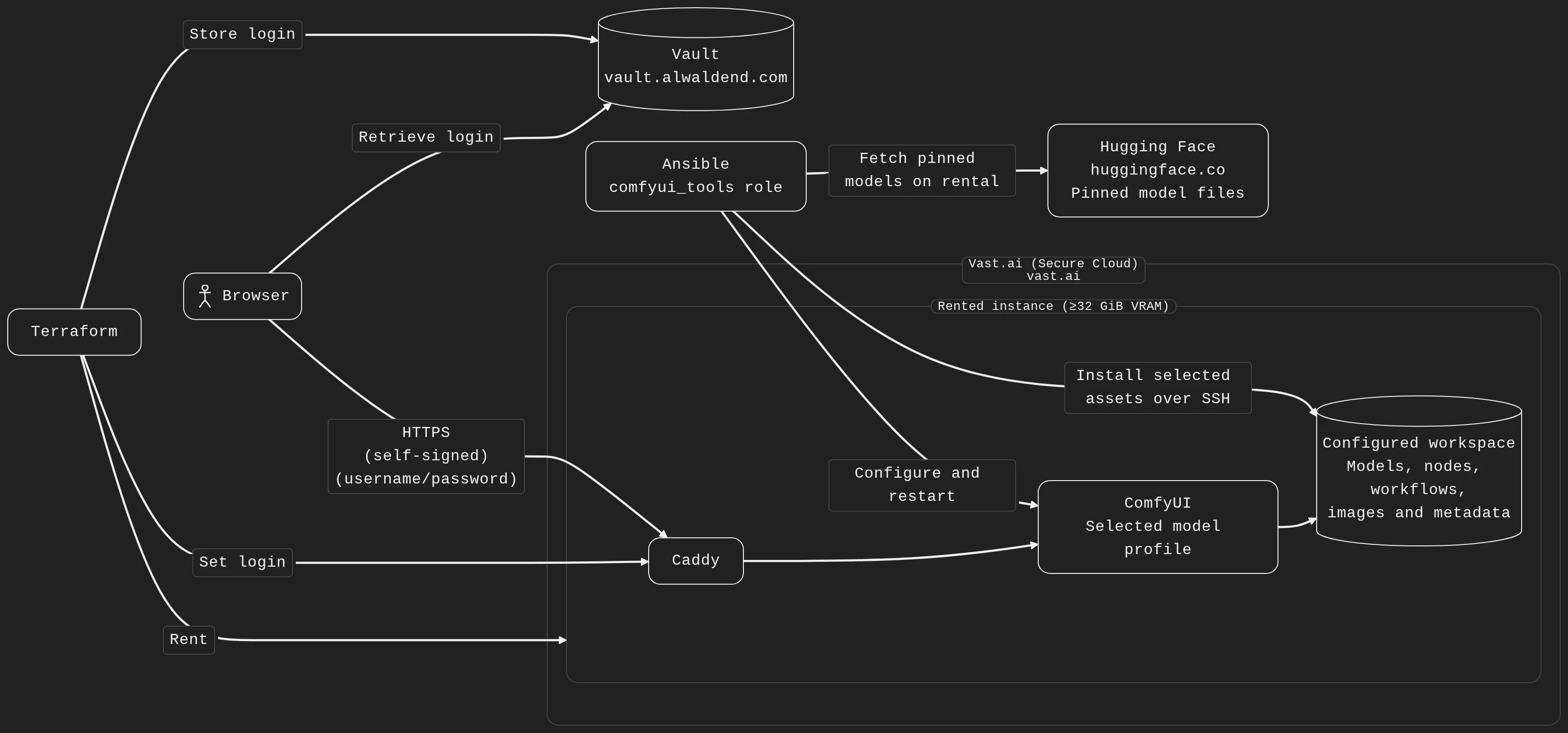
This project owns one image-generation rental in tf_setup.
It uses the reusable ComfyUI module
in exposed mode: a single HTTPS proxy with a generated username/password login,
plus account-key SSH access managed by infra/vastai. The GPU must have at least 32 GiB VRAM.
The configuration selects Qwen-Image-Edit-2511 and the existing
48 GB hardware profile for the operator-requested keyframe animation trial.
The Qwen bundle includes ordinary edits, crop-composited keyframes, selected-frame
GIF assembly, both chained GIF variants and the existing RIFE engine.
NoobAI remains a selectable profile for scene sequences. The NoobAI App has a six-image, two-scene default, persistent references and
one combined GIF, with optional Canny structure guidance and RIFE interpolation.
Separate reference-sequence and scene-composer Apps expose the previous-image
and independent two-pass strategies; the composer uses shared descriptions and
an optional already-installed LoRA instead of image references.
Separate sketch-edit Apps
take a source image and an aligned desired-outline sketch, with a painted-mask
variant for restricted edits. They reuse the existing Canny weights; their GPU
edit quality remains unverified.
The Ansible deployment calls the reusable comfyui_tools
role to install all selected models, LoRAs, node packs, dependencies and native
workflows/Apps, including the pinned interpolation tool when selected.
Terraform provisions the rental and authenticated access. workspace_directory
in the configuration controls the shared workspace path for both stages.
MOSS-Image SFT/Base INT8, full Chroma1-HD, FLUX.2 dev 32B FP8, Juggernaut XL v9,
HiDream-I1 Full 17B, Illustrious XL v2.0-STABLE, FLUX.2 klein Base 9B FP8,
NoobAI XL 1.1 and Qwen-Image-Edit-2511 remain selectable profiles;
see model configuration.
The additional uso and umo-uno profiles provide native FLUX.1 subject/style
and multiple-identity conditioning respectively; both have prompt sequences.
Juggernaut includes the approved IP-Adapter Plus and CLIP vision weights for
several character/style references; NoobAI and Illustrious reuse that SDXL path.
NoobAI’s scene sequence, Canny and interpolated GIF pipeline have completed GPU
execution; precise pose edits and exact character identity remain limited.
Illustrious has offline packaging checks only. HiDream’s GIF
workflow completed the approved eval case, with poor motion/reference quality;
its other workflows remain unverified on a GPU. NoobAI’s publisher prohibits commercial
use of generated products; see the model configuration before selecting it.
Prompt Sequence uses the native multiline
editor; blank lines in line mode provide visual spacing without extra panels.
Identity and state
The component authenticates as src_infra_image_gen, declared by
Vault Terraform. Its own namespace
at mount secrets is alwaldend.com/vault1/approles/src_infra_image_gen:
| Entry | Owner | Purpose |
|---|
vastai | infra/vastai/alwaldend | Dedicated generated team key (api_key) |
web | This project’s tf_setup | Generated HTTPS username/password |
tf_backend/setup | This project’s backend | Rental Terraform state and lock |
huggingface | Operator or external IaC | Optional gated-model read token |
The existing team root creates and delivers the
key using its own issuer and Vault identity. Its delivery policy covers only
this component’s vastai entry. The rental reads that entry through its own
AppRole; it never reads the team’s operator seed or passes an API key to the
container. The operator can bootstrap the role and browse its KV entries through
existing Vault identity membership. No general infrastructure group is required.
Deployment status
Check remaining team credit before
renting or leaving an instance running.
The latest visible-motion trial created 48 GB Qwen instance 60921795 through
Terraform and installed it through the shared Ansible role. It completed the
owned trials and was retained under the operator’s instruction. Its
deployment record
owns the dated connection and cost observations. A later Vault authentication
failure prevented a fresh provider check during PR completion; the record is
not a live status guarantee. The preceding instance 60894930 was destroyed at
the operator’s request before this rental was created.
The preceding 48 GB Qwen trial completed four structural-reference still edits and
then released test instance 60886376. The hand outline guided the pose, but
contact, scene artifacts and duplicate anatomy prevented frame/GIF acceptance.
That trial’s connection outputs were cleared; its
deployment record
records installation, results and teardown.
An earlier rental used NoobAI on the 96 GB RTX PRO 6000 profile,
with retention requested. The original ten workflows were uploaded. Its endpoint
is now unavailable and the provider lookup no longer returns that instance;
the two additional App variants remain packaged for import. The
current deployment record
owns its instance identity, endpoint observations, in-place installation and
sequence/GIF results. Earlier rental observations follow.
The former personal stack was destroyed on 2026-11-10. The replacement AppRole,
scoped policies, dedicated team key, generated web login and component state
remain deployed. The earlier Flux, FLUX.2 dev, NoobAI and HiDream rentals were
destroyed at the operator’s request. The operator-requested deployment on
2026-11-13 created personal instance 60406482. It was subsequently destroyed at
the operator’s request; its connection outputs are cleared and no rental is
managed by this root according to that record. Component credentials remain deployed.
The requested MOSS-Image deployment created instance 60541185 on the named
48 GB RTX PRO 5000 profile. All twelve examples, including six sequence variants,
are staged; single-image SFT text-to-image and
Base layout-guided generation completed. Sequence and edit/control execution remain
unverified. See the historical MOSS deployment record.
USO and UMO-UNO remain source-only alternatives. The
earlier NoobAI record
documents deployment and its verification limits; the earlier Chroma acceptance
retains its historical workflow results. The component did not reuse personal state or credentials. Historical
Vault versions can remain protected; the shared team and operator seed remain.
Deployment is staged: authorize the component role and delivery policy through
Vault Terraform, create the dedicated key through the team root, then rent
through this project’s tf_setup, then install the selected application profile through Ansible. Each live apply requires its own reviewed
interactive plan. Building and testing the source performs none of these steps.
Privacy boundary
The configured Vast ComfyUI image runs ComfyUI on the rented host. It is not a separate hosted
inference API, and this configuration adds no prompt/image upload service or
access logging. ComfyUI can retain generated images and prompt metadata locally;
provisioning scripts and extensions can access those files and the internet.
The image is selected directly by tag in the rental Terraform. Review optional templates, scripts, models, and extensions before use.
Vast’s privacy policy covers its account and website
processing; it does not establish a blanket no-retention or no-training promise
for this stack. Vast’s security FAQ
describes tenant isolation and recommends Secure Cloud providers for sensitive
workloads. The module requests datacenter/verified offers and checks returned
hosting_type=1 and verification=verified, rejecting absent tier metadata.
This selects Vast’s certified datacenter tier; it does not establish
confidentiality against the host administrator. SSH and HTTPS
protect transport, not a workload from its machine’s administrator.
Gated Flux downloads require a read-only Hugging Face token whose account has
accepted the publisher’s non-commercial license. The operator or external IaC
stores it in the huggingface entry as field token; this component only reads
it. The authenticated Ansible entry point receives it through AL injection for the gated profile and supplies it to the publisher download request.
The token is visible to rental processes and the host administrator. No Vault or
Vast account key is passed to the rental.
Keep wanted images locally and export them before releasing the rental. Stopping
retains billable storage. Destruction removes the contract’s local storage but
this project cannot verify physical erasure or exclude host-made copies.
Generated login credentials also remain in the Vault-backed Terraform state
and may remain in historical Vault secret/state versions. There are no public
password outputs. Destroying the rental does not revoke copies already disclosed.
Command-line access
For agent-run acceptance tests, finish local implementation and offline checks
before renting. Keep test rentals only while provisioning, generating or
retrieving results; treat roughly three minutes without active test work as
idle. Destroy the rental through the owning Terraform workflow before coding,
review or other local work, and clear its connection outputs with refresh-only
apply. Personal rental creation and release remain manual reviewed operations.
The separate evals composition automates only its labeled evaluation rentals. An instance being used by the
operator is outside this disposable-test rule.
The authenticated target obtains the current HTTPS URL from the owning
Terraform output target and retrieves the login through the component AppRole:
bazel run //infra/image_gen:comfy -- --json system-stats
bazel run //infra/image_gen:comfy -- run --workflow /absolute/path/workflow.json --wait
bazel run //infra/image_gen:comfy -- --json jobs status PROMPT_ID
bazel run //infra/image_gen:comfy -- download PROMPT_ID -o /absolute/path/outputs
Use upload /absolute/path/reference.png to stage a reference first. The CLI
accepts API and native UI workflow JSON. Authenticated commands use temporary profiles under ignored out/comfyui/cli
and query server history for later status/download commands. Prompts, uploads
and outputs stay out of Git. The bridge verifies the pinned official Vast root certificate and the
endpoint hostname, then adds the Vault login. It closes when the CLI exits and
does not expose management services. A missing rental URL fails clearly.
Use //tools/comfyui:cli for upstream help or unauthenticated/local use.
Reusable nodes and workflow files belong to
ComfyUI tools. For several panels, open
the selected profile’s prompt-sequence workflow and follow its
panel instructions.
For scene-aware NoobAI generation, use
noobai-image-sequence.
It opens as a native ComfyUI App with persistent references, previous-image edits
and explicit fresh-scene breaks. Its node is staged only with that workflow.
One combined GIF is generated for the selected sequence. Live deployment
observations belong to the maintained deployment record.
Automated evaluations
The separate evals composition configures parallel temporary
workloads, result collection and namespace-wide final/manual cleanup. Its code
and cases belong to ComfyUI tools. It does not use this personal rental’s
Terraform state and does not rent during source validation.
Architecture diagram
The diagram source is docs/architecture.mmd. It uses the
shared Alwaldend dark palette and typography, composed with the existing Mermaid
actor artwork for the requested browser actor. The local template derives both
from their owners. Build the WebP with
bazel build //infra/image_gen/docs:architecture_dark_webp. The documentation
consumes the rendered target directly; generated images are not checked in.
The diagram describes the configured
architecture, not an active rental. The simplified certificate label refers to
Vast’s non-public instance trust chain; see the base module’s certificate guidance.
1 - Image generation provisioning
Generate a Vault-backed login and rent one HTTPS-protected ComfyUI instance
This Terraform root generates a 48-character random alphanumeric password,
stores {username, password} at mount secrets, path
alwaldend.com/vault1/approles/src_infra_image_gen/web, and then rents
one ComfyUI instance with that login. A failed Vault write prevents rental creation.
The backend stores state under the component AppRole’s tf_backend/setup namespace.
The rental credential is injected as VAST_API_KEY; Vault provider authentication
is injected separately through AL. No account API key is passed to the container.
Rent and connect
First deploy the src_infra_image_gen AppRole and exact-path team-writer
policy through Vault Terraform.
Then run team credential setup to generate
and store a fresh key in this component’s namespace. The component credentials
are deployed; the previous Flux rental and its Base replacement were destroyed at the operator’s request. These remain operator instructions. The
acceptance record
owns the observed rental and workflow results.
The module uses
the direct Vast ComfyUI/CUDA 12.9 image tag declared in config.json,
without inheriting stock template options. The root selects an explicit published release tag. Update that one image reference to select a newer build;
there is no registry lookup or helper executable during Terraform planning.
Changing the tag produces a reviewed replacement plan for an existing rental.
The component’s config.json owns the image, HTTPS username,
selected model/hardware profiles and their definitions. Terraform has no root
input variables or tfvars presets. Read that configuration for the selected
model and hardware; selections can change between authorized trials.
Other model profiles remain available
as chroma-hd, flux2-dev, juggernaut, hidream-i1-full, illustrious, flux,
qwen, noobai, uso and umo-uno. Selecting a profile does not rent until an explicitly authorized apply.
Application installation is a separate Ansible stage.
Every profile’s complete workflow catalog, models, LoRAs and approved nodes are
installed by the shared role after the existing image initializes ComfyUI.
workspace_directory in config.json is passed to this module and the role.
Terraform does not carry those asset payloads in startup or state. Account-wide
SSH access is managed by infra/vastai, using the
host user’s Vault metadata. Deploy that policy and registration before relying
on the host key to run Ansible; no private key is copied to the rental.
bazel run //infra/image_gen/tf_setup:tf.plan
bazel run //infra/image_gen/tf_setup:tf.rent
rent displays the interactive plan; review it before approving. The selected
48gb hardware profile requires RTX PRO 5000 Blackwell, at least 47 GiB reported
VRAM, 100 GB disk and a USD 1/hour ceiling. The optional 96gb profile requests
at least 95 GiB reported VRAM, 150 GB disk and a USD 3/hour ceiling.
The optional standard profile requests one GPU with at least 32 GiB VRAM, 100 GB
disk and a USD 1/hour ceiling including disk. The module selects the cheapest
qualifying Secure Cloud offer. The ceiling is not a total budget and market
availability is not guaranteed.
Model and hardware selections are independent. The named GPU filter applies
only to 48gb; other profiles retain automatic GPU selection.
Creation acknowledges a contract; boot and provisioning take longer. Refresh
through the same owner after boot, reviewing its interactive plan:
bazel run //infra/image_gen/tf_setup:tf.refresh
bazel run //infra/image_gen/tf_setup:tf.output
https_url remains absent until a refresh reports the public IP and mapped port.
Verify the Vast instance certificate before entering credentials; follow the
module’s certificate guidance.
Retrieve the login through an authorized Vault client using the reference above;
do not paste it into logs or command arguments. ssh_forward_command provides
an alternative for account SSH keys. Export images before release:
bazel run //infra/image_gen/tf_setup:tf.release
Changing the password or access settings replaces the instance; export files
first. Destroy removes all versions of the managed web-login entry. Protected historical
Terraform state versions can still retain credentials. The root has
no automatic expiry or spend cutoff. See the privacy boundary.
Offline validation
bazel test //infra/image_gen/tf_setup:all
The checks omit the live backend, validate the actual module/provider schema,
and exercise password generation and Vault persistence with a mocked Vault and
overridden rental module; the separate CLI E2E suite covers the actual rental module. They do not write Vault or rent
capacity. The provider’s Terraform CLI acceptance suite emits separate SSH and
HTTPS lifecycle artifacts. The ComfyUI module checks cover alternate workspace
paths, empty application provisioning and the 16 KiB startup limit. The separate
Ansible role fixture verifies model destinations, source installation, workflow
preservation and safe repeat application using disposable local inputs. Neither
check downloads real weights or evaluates generated images. Actual image startup and TLS/authentication require
a separately scoped live acceptance run.
Download models
model_profile in config.json selects matching model downloads and saved workflows.
Every saved name uses <profile>-<purpose>, matching its generated JSON filename:
Juggernaut also stages juggernaut-multi-reference and
juggernaut-multi-reference-prompt-sequence, with three shared character/style
references through IP-Adapter Plus. The two additional public safetensors files
add about 3.4 GB: the SDXL Plus adapter in models/ipadapter and its CLIP-ViT-H
encoder in models/clip_vision. Their publisher revisions are fixed in config.json.
NoobAI provides noobai-image-sequence and its first-party image_sequence module.
The Ansible deployment installs the module, every
selected native workflow/App, approved Canny checkpoint and pinned RIFE engine.
All profiles use the same installation role; no workflow is embedded in startup.
This native ComfyUI App reuses original IP-Adapter
references across scenes, starts each scene from fresh noise and edits the preceding
image for subsequent actions. A line containing --- starts a new scene. The
App instructions
cover uploads, change strength, continuation and one combined GIF. The
default includes three related poses in each of two scenes. GPU and reference
quality acceptance belongs to the current deployment record.
The separately named reference-sequence and scene-composer Apps compare that
carry-forward approach with independent two-pass sampling, fixed shared prompt
fields and optional installed LoRA weights. Both retain scene boundaries and
individual PNGs, and neither publishes per-scene GIFs.
| Profile | Bundle | Native workflows |
|---|
juggernaut | Juggernaut XL v9 all-in-one SDXL checkpoint | juggernaut-text-to-image, juggernaut-image-to-image, juggernaut-prompt-sequence, juggernaut-style-reference, juggernaut-style-prompt-sequence |
noobai | NoobAI XL 1.1 all-in-one SDXL checkpoint, SDXL Plus adapter and CLIP vision | Seven purposes as Juggernaut, plus img2img prompt sequence; prefixed noobai- |
illustrious | Illustrious XL v2.0-STABLE SDXL checkpoint, SDXL Plus adapter and CLIP vision | Seven purposes as Juggernaut, prefixed illustrious- |
hidream-i1-full | HiDream-I1 Full 17B FP16, four local text encoders, FLUX VAE | Eight purposes: txt2img, img2img, their prompt sequences, style and its sequence, and both GIF paths; prefixed hidream-i1-full- |
chroma-hd | Full Chroma1-HD, FP16 T5 encoder, FLUX VAE | chroma-hd-text-to-image, chroma-hd-image-to-image, chroma-hd-style-reference, chroma-hd-prompt-sequence, chroma-hd-style-prompt-sequence, chroma-hd-image-to-image-gif |
flux2-dev | FLUX.2 dev 32B FP8, local Mistral FP8 encoder, FLUX.2 VAE | flux2-dev-text-to-image, flux2-dev-single-reference, flux2-dev-single-reference-prompt-sequence, flux2-dev-multi-reference, flux2-dev-multi-reference-prompt-sequence |
flux | FLUX.2 klein Base 9B FP8, Qwen3 8B mixed FP8 encoder, Flux small-decoder VAE | flux-single-reference, flux-character-style, flux-prompt-sequence |
qwen | Qwen-Image-Edit-2511 mixed FP8, Qwen 2.5 VL 7B FP8 encoder, Qwen VAE | qwen-single-reference, qwen-character-style, qwen-prompt-sequence |
uso | FLUX.1 dev FP8 all-in-one checkpoint, USO LoRA/projector and SigLIP vision encoder | Subject reference, style reference and combined subject/two-style references, each with a sequence; prefixed uso- |
umo-uno | Same FLUX.1 dev FP8 checkpoint and UMO-UNO LoRA | Single and three-identity references, each with a sequence; prefixed umo-uno- |
All files are fixed to publisher revisions in config.json.
The full Chroma bundle totals about 28 GB. The optional 32B and HiDream
bundles each total about 55 GB of model files. Model and hardware selections
are independent: choose sufficient disk/VRAM for the bundle; 48gb provides
100 GB disk and 96gb provides 150 GB. No new model is deployed by these additions.
The shared Ansible role downloads them inside the rental using built-in modules.
Every profile installs the first-party Prompt Sequence from its packaged source. Full Chroma and HiDream additionally stage
the first-party chained img2img GIF node, using only ComfyUI’s existing Torch,
NumPy and Pillow packages. Both first-party nodes are whitelisted for those profiles.
Chroma1-HD, HiDream and all three SDXL profiles restore
RES4LYF
at the previously approved revision and the unchanged
hash-locked requirements. Ansible installs them
at those pins using the image’s existing Python environment. The SDXL profiles additionally stage the explicitly approved
ComfyUI_IPAdapter_plus pack at revision a0f451a5113cf9becb0847b92884cb10cbdec0ef;
only those two packs and Prompt Sequence are whitelisted for those profiles.
The general SDXL Plus path uses the existing image environment and requires no
FaceID/InsightFace installation. Flux, FLUX.2 dev and Qwen retain only Prompt Sequence.
The workflow definitions
are compiled from Libsonnet during the Bazel build; the rental receives native
JSON and does not require Jsonnet. The archived Chroma Flash examples remain
available separately and are not staged by the full Chroma profile.
Chroma1-HD stages the already approved RES4LYF pack and its unchanged locked
requirements alongside Prompt Sequence. Native graphs start at 40 Euler/beta
steps and CFG 3; style graphs use 40 RES 2M/beta57 steps and CFG 3 with the
Chroma model patcher. Img2img preserves some reference composition, while the
style path starts from fresh noise and guides style. Neither path guarantees
character identity. Both sequence graphs share their negative prompt across
all nonempty panel lines. This full checkpoint is distinct from the archived
Flash model; additional VRAM alone does not establish better image quality.
Flux uses the publisher’s non-commercial model.
Its checkpoint requires the user’s Hugging Face license acceptance and a read-only
model token. The operator or external IaC supplies the
Vault token entry. The authenticated Ansible entry point injects
it through AL for a profile marked hugging_face_auth, then supplies it to the
Hugging Face request with task output hidden and redirect forwarding disabled.
Missing access must be resolved before creating paid capacity; Juggernaut and Qwen’s public
bundles need no token. All profiles retain at least 32 GiB VRAM and Secure Cloud.
Juggernaut’s all-in-one checkpoint goes in models/checkpoints and supplies
its own CLIP encoders and VAE. Its text-to-image and prompt-sequence graphs
start with a fresh 1024-square latent. The img2img graph resizes and center-crops
the reference to 1024 square, then samples at denoise 0.65. Raise denoise for
larger changes, or lower it to retain more reference structure. All three use
30 DPM++ 2M SDE/Karras steps and CFG 6.5 as starting settings. Describe the
wanted style in the positive prompt. Img2img also carries over composition;
these native graphs do not isolate only a reference’s style or character.
For a reference image’s style with a new scene, use
juggernaut-style-reference. It routes the VAE-encoded reference through
RES4LYF’s style guide and the SDXL model patcher, starting generation from
fresh noise. Describe the scene and broad medium in the positive prompt.
The guide’s weight controls influence; zero disables it. Start at 1 and
compare at the same seed. juggernaut-style-prompt-sequence reuses that guide
for every nonempty prompt line. These are style-guided workflows,
not guarantees of style isolation or character preservation. Their sampler
starts at 30 RES 2M/beta57 steps, CFG 6.5 and full denoise; its controls differ
from the native KSampler graphs. All seven Juggernaut workflows completed with
neutral fixtures on the selected runtime; see the
GPU acceptance record.
Execution does not guarantee reference fidelity or scene adherence. The adapter
workflows give more direct character/style conditioning; lower adapter weight
when references overpower the requested scene.
For FLUX.2 dev, use three Load Image nodes as combined character/style
references. Its native sequence uses the same three reference latents for
every prompt. Start at 1024 square, batch one, 28 Euler steps and FluxGuidance 4.
It uses BasicGuider with distilled positive guidance, so a negative prompt has
no sampling effect in this family. The matching Mistral encoder runs inside the
rental; no remote text-encoding API is configured. The official ComfyUI FP8
bundle is public and does not receive the gated Klein profile’s Vault HF token.
For Flux Base and Qwen, select images in Load Image: image 1 supplies character and output aspect;
image 2, when present, supplies style. Describe the new action/scene and the
reference roles in the positive prompt. Flux uses native reference latents on
both conditioning branches, an encoded empty negative prompt, fresh Flux2 noise, 50 Euler steps and CFG 4.
Qwen retains native vision-language and reference-latent conditioning,
index_timestep_zero, shift 3.1, CFG normalization, 40 Euler/simple steps,
CFG 4 and denoise 1. These are reference-guided generation workflows; they do
not guarantee exact style isolation or character continuity.
Additional model options
MOSS-Image examples
The selected moss-image profile downloads about 21.4 GB from
Comfy-Org/MOSS-Image:
SFT and Base INT8 denoisers, Qwen3.5 9B INT8, the small FLUX.2 VAE, and the
edit and color/depth LoRAs. Files use immutable publisher URLs in config.json.
The model repository declares Apache 2.0. All downloads are public; no model
token, extra node pack or Python requirement is configured.
The six single-image examples cover SFT/Base text-to-image, SFT/Base layout guidance,
image editing and prepared color/depth maps. The Base model is selected only by
the moss-image-base-* examples; the other examples use SFT. Each example has a
prompt-sequence counterpart with shared negative text, progress and grouped
ordered filenames. The catalog lists all twelve, and Ansible installs the
complete selected catalog. See
workflow instructions
for inputs and sampling defaults. The existing ComfyUI v0.44.0 runtime provides
their native nodes. The examples omit optional prompt enhancement and automatic
MoGe depth estimation. GPU acceptance is recorded separately in the
MOSS deployment record.
Other profiles
USO and
UMO-UNO are optional
native ComfyUI profiles. USO downloads about 18.6 GB, including its FLUX.1 dev
FP8 checkpoint with local text encoders and VAE, a LoRA, a style projector and
SigLIP vision weights. UMO-UNO downloads about 19.2 GB, sharing that checkpoint
and adding its own LoRA. All five registry files are fixed to publisher
revisions. Both use the existing runtime image and Prompt Sequence node;
neither installs another custom-node pack or Python requirement. The shared
checkpoint retains the FLUX.1 dev non-commercial license; the USO, UMO and
SigLIP additions use Apache 2.0. These model options have only offline
packaging/graph validation, without GPU or reference-quality acceptance.
For USO, uso-single-reference uses one subject; uso-style-reference uses
one style image; uso-character-style uses one subject and two style images.
Use the same image in both style inputs when only one style reference is
needed. Each has a sequence counterpart. Subject references are resized with
aspect preserved, starting at a 1024-pixel longest side. Style images use the
native SigLIP crop control. UMO-UNO offers a single-reference or ordered
three-reference path; its publisher’s starting reference size is 512 pixels
on the longest side. Repeating one subject in multiple inputs is not a
substitute for separate identities. It has no USO style-projector branch.
Describe reference roles and the wanted scene in natural language.
Both families start from fresh noise, with editable 1024-square output size,
Euler/simple sampling and CFG 1. USO starts at 20 steps and FluxGuidance 3.5;
UMO starts at 25 steps and FluxGuidance 4. The zeroed negative branch has no
effect at CFG 1, including the sequence node’s negative output. Sequences reuse
the same original reference inputs per panel, showing progress and unique
grouped filenames. These are independent reference-conditioned panels, not
joint attention across the sequence. No reference workflow guarantees exact
style isolation or identity continuity.
The profiles below remain selectable; later rental and acceptance observations
belong to the linked deployment record. Model size alone does not predict
comic quality or reference adherence.
- NoobAI XL 1.1 is an SDXL
illustration fine-tune. Its publisher recommends Euler ancestral, 25–30
steps and CFG 5–6. The starting preset uses 30 steps and CFG 5.5. Its custom
license prohibits commercializing the model, derivatives and generated
products, and imposes obligations on derivatives; review it before use.
- Illustrious XL v2.0-STABLE
is another SDXL illustration model under CreativeML OpenRAIL-M. Its matching
starting preset is provisional, not a measured quality recommendation.
- HiDream-I1 Full is a 17B
alternative. The denoiser is FP16; its published Llama 3.1 8B encoder is FP8.
The bundle also reuses the existing FP16 T5 and FLUX VAE, plus model-specific
CLIP-L/G. Native sampling follows the
official workflow:
50 UniPC/simple steps, CFG 5, shift 3. The transformer and CLIP weights use
MIT licenses, T5 and the VAE use Apache 2.0, and Llama retains Meta’s Llama
3.1 Community License. The complete bundle is not licensed solely under MIT.
The 48 GB option can rely on ComfyUI’s model offloading for the larger bundle;
peak VRAM, speed and style-patcher compatibility remain unmeasured. Several
models can be stored on disk and loaded as needed. Two 9B FP16 denoisers alone
need about 36 GB before encoders, activations and runtime overhead; three need
about 54 GB and cannot all remain resident on 48 GB. Quantization changes that
calculation, and ComfyUI may unload models between jobs.
The downloads registry owns each immutable publisher URL and destination kind;
the custom_nodes registry owns approved pack revisions. Each model profile’s
downloads array lists registry filenames, and custom_nodes lists pack names.
HiDream’s components map assigns its four text-encoder roles explicitly.
Add or select registry entries to change a profile’s files. An
empty array disables configured downloads; workflows still require matching
files. URLs must contain no credentials. Source and acceptance assets remain
neutral; private prompts, uploads and generated images do not belong in Git.
Changing model/profile assets is an Ansible update and does not replace the rental.
Image, workspace and access bootstrap changes remain Terraform provisioning changes.
The retired personal rental was destroyed. The new component credentials and
Qwen rental were subsequently deployed under separate user authorizations.
The Base replacement was created and then destroyed at the operator’s request, retaining component credentials. Base GPU workflow acceptance was superseded by that release. Connection coordinates
come from the owning Terraform outputs. Implementation,
teardown and acceptance evidence is recorded in the
owning change.
2 - Image-generation application installation
The playbook loads the profile registry and runtime declaration, translates them
into ordinary role variables, then calls the shared
comfyui_tools role.
It installs every selected workflow/App, model file (including LoRAs and
ControlNet), approved Git node pack, first-party node, hash-locked Python
requirement and optional pinned Video2X/RIFE engine. The existing image supplies
ComfyUI and its Python environment. Both fresh installation and updates use
this same role; Terraform only provisions the rental and secured access.
config.json owns the profile registry and workspace_directory.
The playbook combines that directory with the application name from the
shared runtime declaration. The same workspace setting is passed to Terraform’s
native bootstrap. Changing it is not an in-place migration of existing data.
The role preserves inputs, outputs and unselected files. It waits for aggregate
idle counts before installation, loaded-code changes and restart; it never
reads job prompts, history or queue entries. Changed application inputs notify
one restart. Coordinate an idle maintenance window because another client can
still submit work during installation. Workflows can be copied without restart.
After separately authorized account SSH registration and rental creation, use
the observed Terraform SSH host/port outputs and the corresponding local host
identity. The account registration reads its public key from Vault metadata;
it neither transfers nor creates a private key. Pin the server host key in
operator-owned storage before strict SSH checking.
export IMAGEGEN_SSH_HOST=PROVIDER_REPORTED_HOST
export IMAGEGEN_SSH_PORT=PROVIDER_REPORTED_PORT
export IMAGEGEN_KNOWN_HOSTS="$PWD/out/TASK/known_hosts"
bazel run //infra/image_gen/ansible:ansible.syntax
bazel run //infra/image_gen/ansible:ansible
Pass -- --skip-tags workflows to preserve later App/workflow edits. The syntax
entry point does not authenticate or connect to hosts. Public profiles need no Vault model-token entry. For a gated profile, use
bazel run //infra/image_gen/ansible:ansible.huggingface: the existing AL injector
reads the optional model token through the component identity and exports only
COMFYUI_HUGGING_FACE_TOKEN to Ansible. The role requires it when the selected
profile declares hugging_face_auth and has model downloads. Workflow-only runs
need no token. No Vault or Vast API credential is exported to Ansible or installed
on the rental.
The local role acceptance fixture verifies installation and update safety
without a rental. No deployment is implied by source validation. Changing a
retained instance’s Terraform startup can replace it; use this Ansible target
for application updates instead.
3 - Image-generation evaluations
Bounded parallel ComfyUI evaluation configuration and cleanup
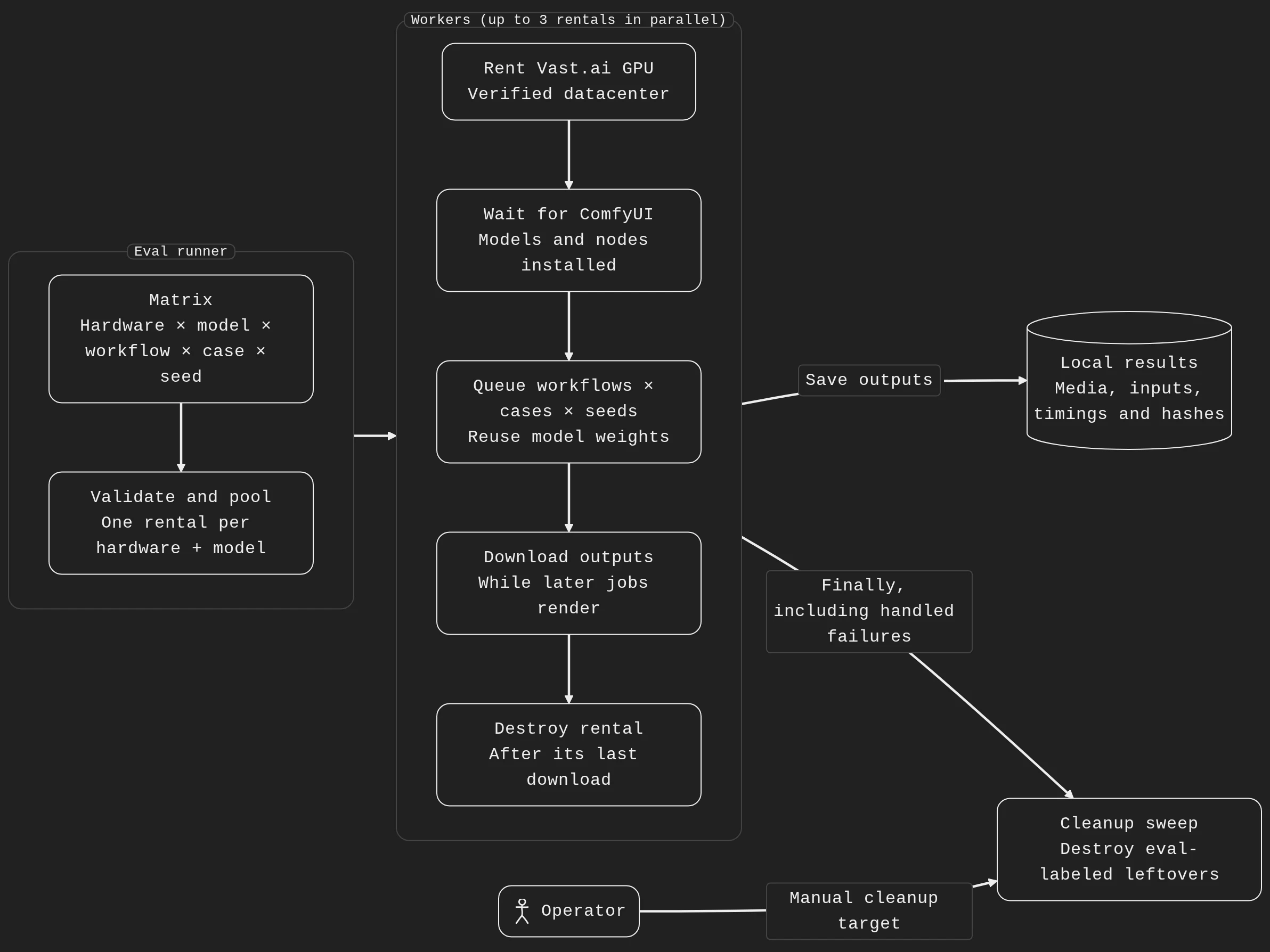
Default cleanup is shown; --cleanup=false retains rentals and skips the final sweep.
This subproject instantiates the reusable evaluator in projects/comfyui_tools.
It owns the run matrix, credential references and deployment targets. All
executable code, cases and references stay with that project. Personal rental
resources and Terraform state remain independent.
The matrix in config.json compares Juggernaut, NoobAI, Illustrious, Chroma and
HiDream on the approved thorn-landscape case, with text-only and reference-guided
workflows. Chroma, HiDream and Qwen also run the plush-petting GIF case. Two fixed seeds
are configured for still images. Hardware and publisher pins come from the parent
config.json. Configuration is not evidence of GPU quality.
Compatible matrix groups cross hardware_profiles, model_profiles, workflow
purposes and case_ids, then apply shared seeds and optional sampling controls.
A purpose such as text-to-image resolves to -text-to-image.json.
Separate groups express compatibility without a second workflow catalog. Unknown
files, unsupported bindings, duplicate axis choices/seeds and expansions above
128 workloads fail locally before allocation. The current matrix expands to
eighteen workflow/case/settings combinations and twenty-eight seeded queue entries, pooled
onto six hardware/model rentals. Add another hardware profile to a group to
compare that rental configuration too.
All workflows, cases, settings and seeds sharing a hardware/model pair reuse one
rental, including across matrix groups. Each worker allocates only when a rental
concurrency slot is available, waits for its own ComfyUI endpoint and immediately
starts submitting native queue entries. A bounded lookahead overlaps submission
with completion waits and downloads, so later jobs can render while earlier
outputs are retrieved. After all its assigned outputs are downloaded, the worker
destroys that rental before local media inspection. If another eval worker
holds the available capacity, an unallocated worker waits and can reuse that
offer after confirmed release. Failed or uncertain reservations stay excluded. A failed workload cancels
further submissions and releases the rental. Confirmed provider exit, removal or
ownership change also cancels active work promptly; transient control-plane
observation errors retain the existing workload deadline. In failure cases, already downloaded artifacts remain.
Maximum parallelism is three rentals. Each has a 45-minute lifetime for its
entire assigned workload, a five-minute readiness deadline and a separate cleanup deadline. The standard hardware profile selects any GPU with at least 32 GiB VRAM,
100 GB disk and a $1/hour reported offer-price ceiling. Offers are ordered by
lowest reported hourly price among offers satisfying both transfer-rate caps;
no GPU model is pinned. The canonical shared offer declaration caps incoming
and outgoing bandwidth at USD 0.04/GB each. This rejects the expensive-transfer
hosts used in the first experiment without disabling any host requirements. Datacenter and verification are
mandatory in both the query declaration and returned tier metadata. The explicit
minimum_reliability value of zero removes only the inherited 99-percent floor;
architecture, CUDA and port requirements remain. The hardware profile caps the
reported hourly offer price. Network fees and delayed
provider operations mean this is not a guaranteed account spend cap. No timer or
persistent service is deployed.
With automatic cleanup enabled (the default), the final step and standalone cleanup use the same rule: destroy every instance
whose label starts with imagegen-eval:image_gen:, regardless of run or age.
They preserve normal rental labels and verify that no matching instances remain
by enumerating all pages of the current Vast v1 instances API.
Run one controller per namespace. A shared per-OS-user cache lock excludes local
controllers with the same namespace even when their output directories differ;
coordinate this operationally across machines or OS accounts. Manual cleanup deliberately terminates matching test rentals too; stop an active
controller before manual cleanup so it cannot allocate more queued jobs. Forced termination or host failure can skip the final
step; invoke the standalone cleanup target to recover.
The existing Vault-owned team key and web login are injected through the parent
component. Only the web login reaches ComfyUI access. The runner never writes
Vault or reads the personal Terraform backend. Startup uses the existing
hardening template, compiled by the pinned Terraform expression evaluator in an
empty directory. Terraform manages no evaluation resources or state.
Results, journals, effective inputs and credential-masked CLI failure diagnostics
are written under ignored
out/imagegen/evaluations/results. Automatic checks cover lifecycle, decodable
media, frame count, timing, looping metadata, distinct frame colors and boundary
pixel difference. Pixel change does not establish a correct petting gesture. Subject adherence, style, reference
following, natural motion and artistic quality have explicit review criteria
and remain unscored until reviewed. Live runs require an explicit operator
invocation; offline checks never rent capacity.
Commands
bazel run //infra/image_gen/evals:check
bazel run //infra/image_gen/evals:run
bazel run //infra/image_gen/evals:gif
bazel run //infra/image_gen/evals:cleanup
For a diagnosed capacity failure, run -- --group GROUP --exclude-offer ID
selects only the requested group and skips that offer for this invocation.
For example, append those arguments to bazel run //infra/image_gen/evals:run.
The IDs must be unique and positive; mandatory host filters remain enforced.
The final report records exclusions. Cleanup still destroys the full namespace.
Only check is offline. Run rents the configured matrix; gif selects only the
three plush groups (Chroma, HiDream and Qwen), producing eight experimental
clips on three reused rentals. Cleanup destroys all
matching evaluation instances. Both live targets require an explicit operator
invocation. Run supplies its final cleanup automatically, including failures
and ordinary interruption. Append -- --cleanup=false to the run target to
retain all allocated rentals after success or failure instead. Both per-rental
destruction and the final sweep are skipped, and run.json records
cleanup_skipped=true and cleanup_confirmed=false. The journal identifies each
retained rental; invoke the standalone cleanup target when debugging is finished. Source validation builds the live targets without
executing them.
To iterate on those retained installations, pass their completed run directory:
bazel run //infra/image_gen/evals:run -- --cleanup=false \
  --reuse-run /absolute/path/to/results/RUN_ID
Select the desired groups or supply revised case/workflow paths as usual. Every
selected hardware/model pair must match exactly one retained installation,
including its declared image, asset/extension pins and hardware configuration.
The journal’s installation fingerprint must also match installed first-party
source, selected requirements contents, runtime settings and startup template.
The source report must belong to the same namespace and provider endpoint.
Live instance labels and running state are checked before work; missing,
released, foreign or incompatible installations fail without new allocations.
Reuse never reinstalls models or restarts services. New iterations get separate
reports and media, preserving prior outputs and original rental identities.
The first run must record provider_endpoint and installation fingerprints;
older retained runs are rejected rather than assumed compatible.
Per-run deadlines bound active work, not continued billing of retained rentals.
Explicit cleanup still destroys the whole eval namespace.
Edit config.json to select matrix groups, profiles, cases, workflow purposes,
seeds and limits. Optional per-group sampling controls include steps, cfg, denoise,
adapter_weight, adapter_end and style_weight. Omitted controls retain the
selected workflow defaults; overrides must apply to every workflow in their
group. Effective workflows and expanded rental/workload identities are saved
with the results. queue_and_generation_seconds includes time spent in the
native queue and CLI polling overhead; retrieval_seconds measures downloads.
completion_observed_at is captured by an independent bounded CLI observer for each
submitted trial, so preceding downloads do not inflate later completion observations.
It is not an authoritative GPU execution timestamp.
Each trial has a forty-minute absolute budget, bounded by the rental’s 45-minute lifetime. The trial retains that deadline across upload, submission, native queue
residence, generation and download. Frame lists use the node’s JSON mode so
multiline entries remain one frame; empty entries fail before uploading.
GIF controls frame_source and frame_seed_mode select original-reference
sampling or feedback and fixed noise or incrementing seeds. The selected
comparisons use fixed noise with feedback at denoise 0.45, original-reference
sampling at denoise 0.65, and a masked version of that original-reference path.
Qwen compares full-image and masked edits at its native denoise 1. The case uses
static hand-pose instructions with identical first/last prompts. Its edit_region
owns the hand rectangle and soft boundary. These are experiments, not a motion
quality guarantee; the previous two-clip baseline is recorded below.
The masked and Qwen GIF graphs are generated repository assets submitted by the
evaluator. They are not added to the personal rental’s startup workflow bundle,
which must stay inside Vast’s compressed startup-size limit. Load the generated
JSON manually when using these experimental graphs outside the evaluator.
The first matrix compares model/workflow combinations with their model-specific
starting settings, not isolated model architectures under an identical sampler.
bazel test //infra/image_gen/evals:configuration_test \
  //infra/image_gen/evals:workload_e2e_test \
  //projects/comfyui_tools/test/evaluation:evaluation_test
The first check validates the actual packaged matrix and canonical startup
template using public dummy login values and no API client. The lifecycle
fixture uses a loopback Vast server and verifies matrix pooling, offer reuse,
namespace locking, early rejection and cleanup; the workload fixture uses the real pinned
CLI through an isolated HTTPS ComfyUI API, including queued image/GIF retrieval
and cancellation of a stalled CLI descendant. These checks cannot evaluate image
quality or establish new GPU/model compatibility.
GIF acceptance
The authorized 2026-11-11 run completed both configured GIF workloads on verified
datacenter CMP 170HX 40 GiB rentals. Both outputs decode as eight 1024-by-960
frames with 170 ms delays and infinite looping. Chroma’s native queue and
generation took 278 seconds; HiDream’s took 410 seconds. These timings include
model loading after submission. Each rental was destroyed after its own
download, and the final paginated sweep confirmed the eval namespace empty.
Media validity passed; convincing petting motion did not. Chroma preserves the
scene with little readable hand motion. HiDream changes more but drifts in
the plush’s appearance and the background. Results remain in ignored local
output, with the detailed evidence in the owning OpenSpec change. The evaluator
recorded successful execution and cleanup; the wrapping Vault plugin separately
reported a token-revocation error during shutdown, so the overall command exited
nonzero. No successful whole-matrix or still-image quality claim follows.
GIF experiment outcome
The subsequent eight-variant comparison retrieved six Chroma/HiDream clips.
Fixed-noise feedback still accumulates severe noise or appearance drift.
Original-reference sampling prevents that accumulation and repeats the initial
frame at the loop boundary, but Chroma barely moves the hand. The masked HiDream
variant produces more localized movement while retaining malformed fingers.
None passes the case’s natural-petting criterion.
Qwen produced no clip: its first rental missed readiness, and a different
verified datacenter offer reached readiness but returned a generation execution
error. The retained CLI summary does not identify the model exception; no cause
is asserted. These Qwen graphs remain experimental, without live GPU acceptance.
All four rentals across the initial comparison and isolated retry were destroyed;
final account enumeration found no instances. Billing and downloaded outputs
remain local, with failed attempts included in the operator’s cost report.
Qwen’s generated GIF workflows now encode each previous decoded image through
the native image-edit encoder for both conditioning branches, and encode those
same pixels for sampling. Their new node must be loaded before these graphs
are used. On the retained rental, an explicitly authorized ComfyUI restart
loads the updated first-party source; saving workflow JSON alone does not.
For an explicitly authorized retained-rental update, the packaged SSH client is
bazel run //infra/image_gen/evals:ssh -- -p PORT root@HOST COMMAND. Supply the
current instance’s provider-reported endpoint and existing account SSH identity.
The target keeps batch authentication and strict host-key checking enabled;
bootstrap a task-owned host-key pin before first use. It never selects or
discovers user jobs.
The later native-decoder retry retrieved both Qwen clips. After the operator
authorized a service update, both corrected decoded-image feedback variants
also completed, producing eight-frame GIFs. Full-image feedback still drifts
and deforms fingers; the masked variant remains almost static. Neither passes
the petting criterion. The operator subsequently requested destruction, and
account-wide enumeration confirmed zero rentals. The selected NoobAI personal
configuration is source-only and has not been rented.